
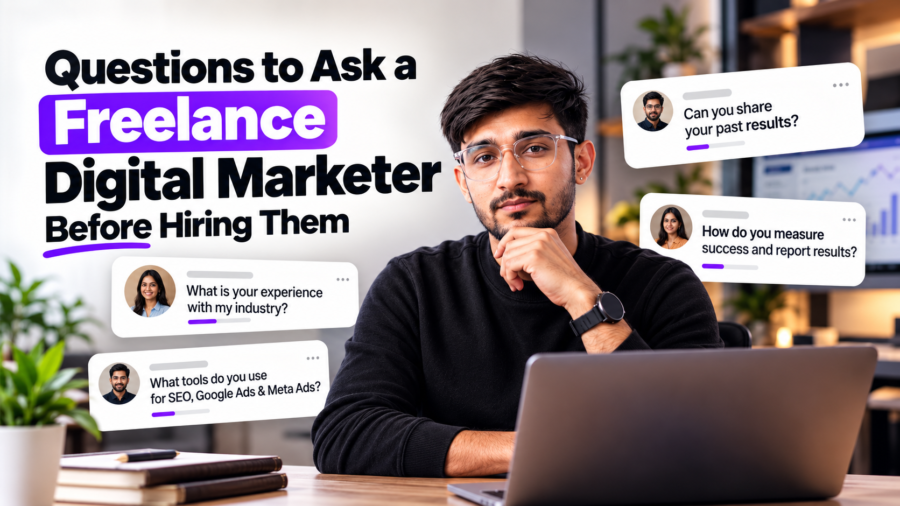
Questions to ask a freelance digital marketer before hiring them

Questions to ask a freelance digital marketer Before Hiring

Hiring a freelance digital marketer is a leap of faith, at least until you know what to ask. Most business owners go into these conversations with one broad question in mind, something like can you grow my business, and come out with a vague yes and not much else to judge the person on. The better approach is to ask specific questions that reveal how someone actually works, not just what they claim to know.

This guide is not a list of thirty questions to fire off in one call. It focuses on the handful that genuinely separate a capable freelancer from someone who sounds confident but cannot back it up. For each one, you will also see why it matters and what a useful answer sounds like, so you know what you are listening for.

Questions About Experience and Past Results of a Digital Marketer

Can you show me relevant work or explain a project in detail?

Why it matters: a portfolio link tells you almost nothing on its own. What matters is whether the freelance digital marketer can walk you through what the business needed, what they actually did, and what changed as a result.

What a useful answer sounds like: they describe the starting point, the specific actions taken, and honest numbers, even if the numbers are modest. They are comfortable naming limitations too.

Has a digital marketer worked with businesses similar to mine?

Direct industry experience is not mandatory, but it does shorten the learning curve. If the freelance digital marketer has not worked in your space before, ask how they plan to close that gap quickly, rather than treating it as disqualifying.

Can you tell me about a campaign that did not go as planned?

This question is more revealing than any success story. Someone who can explain a failure clearly, what they expected, what actually happened, and what they changed, is showing you how they think, not just what they have achieved.

Questions About Strategy, Channels and Creative Work

How would you approach my business in the first thirty to ninety days?

A digital marketing freelancer who has done this before should be able to sketch a rough plan on the spot, even a simple one covering what they would review first, what they would test, and when you should expect to see early signals.

Which channels would you prioritise for my business, and why?

Watch for a straight answer here rather than a pitch for every service they offer. A freelancer who genuinely understands your business will often tell you that one or two channels matter more than the rest right now, and explain why.

Can this one person actually manage SEO, Google Ads, Meta Ads and creative work

This is where you need to be careful. A freelancer who lists SEO (What is SEO), Meta Ads, Google Ads and AI generated video and image creatives as services is not automatically equally strong in all four. Ask directly which of these channels they have hands on, recent experience in, and which channels your business genuinely needs right now.

A good answer sounds like this: I have run Meta Ads and handled SEO closely for the last few years, and I bring in AI tools for creative production rather than treating video and design as an afterthought, so you get a coordinated output instead of four disconnected services. A weaker answer treats every channel as equally strong with no specifics attached to any of them.

Questions About Reporting, Communication, Ownership and Pricing

What will I actually receive each month, and how often will we talk?

Ask for the specifics. A monthly report is not useful if it only shows impressions and followers. Ask which metrics they will track and how those metrics connect to your business goals, such as leads, sales or bookings, not just traffic.

Who owns the ad accounts, analytics properties and website access?

This question matters more than most business owners realise until they try to end a contract. The standard and fair practice is that your Google Ads account, Meta Business Manager, Google Analytics property and any creative assets are set up in your name from day one, with the freelancer given access as a manager rather than as the owner. If a freelancer creates these accounts under their own name or personal login, you risk losing your historical campaign data, conversion tracking and audience lists if the relationship ever ends. Ask this before work begins, not after.

What exactly is included in your fee, and what is not?

Get clarity on whether ad spend, stock assets, or premium tools sit inside the fee or outside it. Ask how additional requests outside the agreed scope are handled and priced, so there are no surprises later.

What happens if I want to end the engagement?

A freelancer worth working with should be able to tell you, without hesitation, that you keep full access to your accounts, data and creative assets whenever the engagement ends.

Red Flags to Watch For and a Quick Vetting Checklist

Keep an eye out for a few warning signs that show up again and again in hiring guidance across the industry.

  • Guaranteed rankings, guaranteed leads or a specific number one Google position promised on a timeline. No one, including Google itself, can guarantee a specific ranking, and a promise like this usually signals risky shortcuts rather than genuine skill.
  • Vague answers about past work, such as claiming they increased growth without explaining what was actually done or measured.
  • Unwillingness to clarify who will own your ad accounts, analytics and creative assets.
  • Pricing or scope that stays unclear even after you ask directly.
  • A portfolio the freelancer cannot explain in their own words.

Freelancer or Agency, and Final Thoughts

Good questions protect you from a bad hire, but they will not tell you whether a freelancer is the right model for your business in the first place. If you are still weighing that broader decision, budget, contract length, flexibility and how much bench depth you actually need, it is worth reading our detailed comparison, Freelance Digital Marketer vs Digital Marketing Agency: Which Is Better, before you start shortlisting anyone.

Once you know a freelancer is the right fit, the questions in this guide do the real work. Ask about actual past results rather than claims, get clarity on who owns your accounts and data, and be specific about which channels the person is genuinely strong in rather than assuming a wide service list means equal expertise everywhere. A freelancer who answers all of this clearly, without defensiveness, is usually someone worth trusting with your marketing.

If you want to talk through your specific requirements across SEO, Meta Ads, Google Ads, and AI powered creatives before you decide, reach out directly.
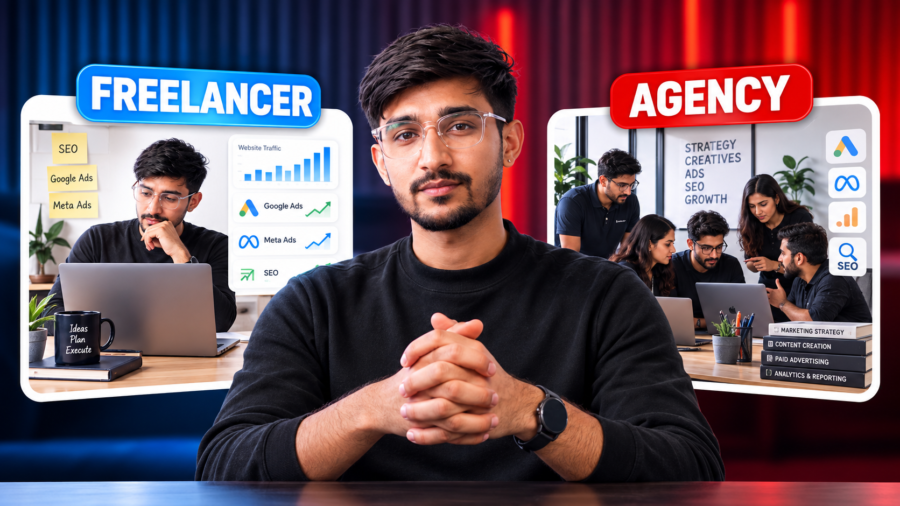
Freelance digital marketer vs digital marketing agency

Freelance Digital Marketer vs Digital Marketing Agency

If you’re comparing a freelance digital marketer vs a digital marketing agency, the right choice depends on your budget, marketing needs, number of channels, and how much direct involvement you want. Both options can work for a small business or growing company, but they offer very different levels of flexibility, specialist support, cost, and scalability. This guide breaks down the differences so you can choose based on your current situation rather than generic pros and cons.

    Freelance Digital Marketer vs Digital Marketing Agency: What’s the Difference?

    Every freelancer versus agency decision comes down to one trade-off. A freelancer gives you one experienced person who understands your whole business, picks up your priorities quickly, and works directly with you. An agency gives you a team of specialists, each focused on one part of the puzzle, backed by processes and tools built for scale.

    Neither of these is automatically better. A freelancer suits businesses that need one or two things done well, want direct control over who touches their brand, and are not yet spending heavily across multiple channels. An agency suits businesses that need several channels running together, such as SEO ( What is SEO ), Google Ads, Meta Ads, and content, all coordinated under one strategy, and that want the account managed rather than personally supervised.

    Can a single freelancer realistically replace a full agency team? For a narrow scope, yes, easily. For a genuinely multi-channel operation, it depends entirely on the freelancer. Most freelancers specialise in one or two skills. A smaller number position themselves the way an agency would, offering SEO, paid ads on Meta and Google, and creative production including AI-generated video and image assets, all from one person or a small connected team. That kind of freelancer closes a real gap for small businesses that need breadth but are not ready for agency pricing.

    Freelancer vs Digital Marketing Agency: Cost and Contracts

    Cost is usually the first thing business owners compare, and it is where the two options genuinely diverge.

    Freelancers typically charge by the hour or by project. Hourly rates for digital marketing work commonly fall between 25 and 150 dollars depending on the skill and the freelancer’s (Questions to ask a freelance digital marketer Before Hiring) experience, and a defined project can be quoted as a flat fee. There is often no long-term commitment attached. You can hire for a single month, a single campaign, or an ongoing arrangement that you renew informally.

    Agencies work mostly on monthly retainers. Small to medium projects commonly run from 1,000 to 5,000 dollars a month, while comprehensive multi-channel campaigns can reach 10,000 to 20,000 dollars a month or more. Many agencies also set a minimum account size, sometimes around 4,000 dollars a month, before they will take you on at all. Retainer contracts commonly ask for a minimum commitment of three to twelve months, and it is common for agencies to point out that channels like SEO need several months of consistent work before results become measurable, which is why they build that minimum into the contract.

    A useful way to think about the real cost of a freelancer is to include your own time. If a freelancer needs several hours of your management time every week to stay coordinated, that time has a cost too, even if the invoice looks smaller than an agency’s.

    Freelancer vs Agency: Speed, Flexibility and Communication

    This is the category where freelancers have a genuine, consistent edge.

    A freelancer can usually start within days, sometimes the same week, because there is no internal team to schedule around and no onboarding process for multiple departments. If you want to test a new channel for one month, or you need to pivot your strategy quickly because something in the market changed, a freelancer can move with you without renegotiating a contract.

    Communication is also more direct. You are talking to the person actually doing the work, not a project manager relaying information from a specialist two or three steps removed. That shortens feedback loops and reduces the chance of your instructions getting diluted along the way.

    Agencies, by contrast, are juggling multiple clients and multiple internal timelines at once. That makes their schedules more structured, which is good for predictability but less good for sudden changes. A mid-campaign shift in budget or direction may need to go through an internal approval process before it happens, and some agencies charge extra for scope changes outside the agreed plan.

    Digital Marketing Agency vs Freelancer: Scale and Specialist Support

    This is where the balance flips in the agency’s favour, and it is the part freelancers cannot fully replicate.

    An agency gives you access to a bench of specialists rather than one person’s bandwidth. If your SEO person is on leave, someone else can step in. If you suddenly need a video editor, a copywriter, and a media buyer working together on one launch, the agency already has that structure in place. This matters most once a business is running three or more marketing channels at the same time and needs them working from one coordinated strategy rather than as separate efforts.

    There is also a real risk consideration with freelancers that businesses often underweight. Freelance engagements can end for reasons outside your control, whether that is the freelancer taking on other work, going through a slow period, or simply moving on. When that happens with a single generalist handling most of your marketing, you can be left with a genuine single point of failure, and finding and onboarding a replacement takes real time. An agency, because it is a team rather than one person, absorbs that kind of disruption without your campaigns stopping.

    Agencies also tend to have more structured reporting, established tools, and staff who stay current through ongoing training, simply because that is part of running a larger operation.

    Freelancer or Agency: Which Is Right for Your Business?

    There is no single correct answer here, but there is a correct answer for your specific situation. Use this checklist to find it.

    Is a freelancer or an agency better for a small business? For most very small businesses and solo founders just getting started, a freelancer is usually the more sensible entry point because the cost and commitment are lower. What do you lose by not hiring an agency at that stage? Mainly bench depth and built-in redundancy, which rarely matter yet when your marketing needs are still narrow. What you gain with a freelancer is direct access to the person doing the work and the flexibility to change course without renegotiating a contract

    The middle ground worth knowing about is a freelancer who deliberately builds agency-style breadth into one practice, covering SEO, Meta Ads, Google Ads, and AI-powered video and image creatives together. This gives a small business coordinated multi-channel marketing without the agency minimums or the long retainer lock-in, as long as the freelancer has genuinely proven capability across those areas rather than just listing them as services.

    Conclusion

    Neither a freelancer nor an agency is universally better. A freelancer wins on cost, speed, and direct communication, and suits businesses with a narrow, clearly defined need. An agency wins on bench depth, coordinated multi-channel execution and continuity, and suits businesses spending more and running several channels at once. The decision checklist above should tell you which side of that line your business sits on today, and that can change as you grow. Start with what your current budget and channel needs actually require, not with a general opinion about which option is better.

    If your business needs SEO, Meta Ads, Google Ads, and AI-powered creatives handled together, without committing to a large agency retainer, it is worth talking to someone who works this way.

    Akkshit Singh
    Phone: +918769686502
    Email: heyakkshit@gmail.com